
Solar Tracker vs Fixed Tilt: A Lifecycle Cost Framework for Utility-Scale Projects
August 17, 2026
Key Takeaway
Fixed-tilt systems are static; single-axis trackers rotate to follow the sun. Trackers deliver 15–25% more energy at higher upfront cost—the decision hinges on whether the yield gain justifies the premium over 25 years. Wood Mackenzie confirms single-axis tracking offers Europe's lowest LCOE in 2025, reaching $37/MWh in MENA.
The choice is about LCOE, not CAPEX—and the right tracker platform makes the difference. Antaisolar's lineup—TAI-Simple (LCOE-first 1P), TAI-Universal (bifacial-optimized 2P), and AT-Spark (installation and material efficiency)—provides EPCs and developers with tailored solutions across the four dimensions that matter: initial cost, installation labor, 25-year stability, and lifecycle service.

The choice is about LCOE, not CAPEX—and the right tracker platform makes the difference. Antaisolar's lineup—TAI-Simple (LCOE-first 1P), TAI-Universal (bifacial-optimized 2P), and AT-Spark (installation and material efficiency)—provides EPCs and developers with tailored solutions across the four dimensions that matter: initial cost, installation labor, 25-year stability, and lifecycle service.
Solar Tracker vs Fixed Tilt: The Yield Gap
Fixed Tilt vs Single Axis Tracker: Why Single-Axis Is the Industry Mainstream
The two tracker types available in the market: single-axis and dual-axis trackers.
Dual-axis trackers rotate on both horizontal and vertical axes, tracking the sun's daily path and seasonal elevation changes. Dual-axis trackers can achieve the highest power output, but at a high cost.
Dual-axis trackers rotate on both horizontal and vertical axes, tracking the sun's daily path and seasonal elevation changes. Dual-axis trackers can achieve the highest power output, but at a high cost.
| Comparison Dimension | Single-Axis Tracker | Dual-Axis Tracker |
| Energy gain vs. fixed-tilt | 15–25% | 30–45% |
| Cost premium over fixed-tilt | 10–15% | 200–300% |
| Mechanical complexity | Moderate | High |
| O&M requirements | Low to moderate | High |
| Best-fit project scale | Utility-scale (standard) | Niche / specialty applications |
Single-axis trackers represent the balance between energy yield and capital investment among available tracking technologies. They rotate on a single horizontal axis to follow the sun's east-west path, delivering the 15–25% annual energy uplift that has established them as the predominant choice for utility-scale PV deployment worldwide.
Fixed-tilt systems, in contrast, capture solar irradiance at a single optimized angle. The inherent limitation of this design is its inability to capture morning and afternoon off-axis irradiance — a substantial portion of daily solar resource.
Peer-reviewed studies document annual energy gains ranging from 12.9% to 20.1% for single-axis tracking relative to fixed-tilt PV, with certain analyses reporting 10–25% higher yield depending on site conditions.
Bifacial amplification extends the yield advantage further. Bifacial modules deployed on horizontal single-axis trackers have become the industry standard for achieving the lowest LCOE. The tracker configuration elevates modules and minimizes rear-side shading — conditions that enhance bifacial gain, a capability that fixed-tilt systems cannot replicate.
Fixed-tilt systems, in contrast, capture solar irradiance at a single optimized angle. The inherent limitation of this design is its inability to capture morning and afternoon off-axis irradiance — a substantial portion of daily solar resource.
Peer-reviewed studies document annual energy gains ranging from 12.9% to 20.1% for single-axis tracking relative to fixed-tilt PV, with certain analyses reporting 10–25% higher yield depending on site conditions.
Bifacial amplification extends the yield advantage further. Bifacial modules deployed on horizontal single-axis trackers have become the industry standard for achieving the lowest LCOE. The tracker configuration elevates modules and minimizes rear-side shading — conditions that enhance bifacial gain, a capability that fixed-tilt systems cannot replicate.
Generation Curve Shape
Fixed-tilt systems generate a sharp bell-shaped curve centered around solar noon. This creates two challenges: over-generation during midday hours when wholesale prices may be depressed, and steep ramping requirements for grid operators as production drops sharply in late afternoon.
By following the sun, solar trackers shift more production into midday and early afternoon hours. This aligns better with:
• PPA structures that value peak-hour generation
• Grid demand patterns in markets with afternoon load peaks
• Storage integration, where flatter production reduces battery cycling requirements
Solar Tracker vs. Fixed-Tilt: The 25-Year Cost Equation
For utility-scale projects, the solar tracker vs fixed tilt cost comparison must be evaluated over the full project lifecycle. The 25-year horizon is the industry standard for LCOE calculations, module warranties (typically 25–30 years), mounting structure design life, and investment return modeling. This is the timeframe that determines whether a tracker's energy premium justifies its upfront cost.
CAPEX: Hardware Premium, Foundations, Installation Labor
Fixed-tilt: Lower hardware cost, simpler foundations, predictable installation. No motors, controllers, or moving parts. Total installed costs for utility-scale fixed-tilt averaged $1.90/WAC ($1.35/WDC) in 2024. The structure performs identically on day one and in year twenty.
Tracker: Carries a CAPEX premium of $80–120/kW (typically 10–20% higher than fixed-tilt). Total installed costs for tracking projects averaged $1.61/WAC ($1.22/WDC) in 2024—tracking systems actually recorded lower overall costs per watt of AC capacity, as they can achieve a target energy output with fewer modules.
On CAPEX per watt of AC capacity, trackers have narrowed or even reversed the gap. At the same time, the real metric is LCOE—not upfront cost alone.
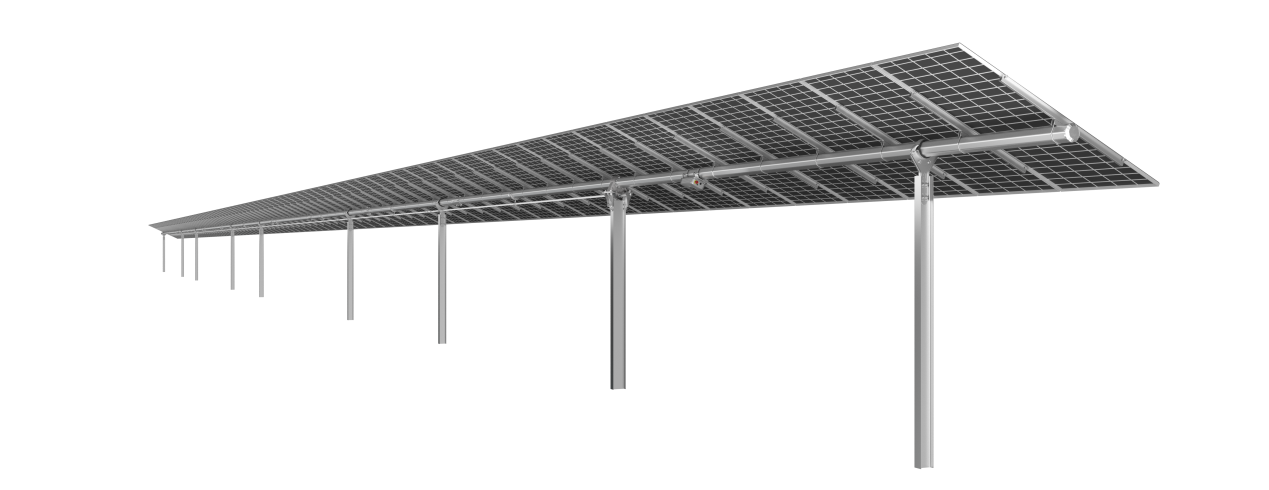
Where the gap narrows: Antaisolar's AT-Spark reduces material costs by 30%, piles by 20%, and improves installation efficiency by ~25%. TAI-Universal's 80m span reduces foundation counts.
Tracker: Carries a CAPEX premium of $80–120/kW (typically 10–20% higher than fixed-tilt). Total installed costs for tracking projects averaged $1.61/WAC ($1.22/WDC) in 2024—tracking systems actually recorded lower overall costs per watt of AC capacity, as they can achieve a target energy output with fewer modules.
On CAPEX per watt of AC capacity, trackers have narrowed or even reversed the gap. At the same time, the real metric is LCOE—not upfront cost alone.
Where the gap narrows: Antaisolar's AT-Spark reduces material costs by 30%, piles by 20%, and improves installation efficiency by ~25%. TAI-Universal's 80m span reduces foundation counts.
O&M: Moving Parts, Monitoring, and Reliability
Fixed-tilt: No moving parts. O&M consists of module cleaning, inverter maintenance, and vegetation management — predictable and low-cost. Industry O&M costs range from $8–17/kW/year. No wear cycles, no mechanical expertise required.
Tracker: Introduces motors, bearings, sensors, and control firmware—each a potential failure point over 25 years. Industry data places tracker O&M costs at 15–30% above fixed-tilt — approximately $3–5/kW/year additional OPEX.
On LCOE, the tracker's higher O&M is often justified by its 15–25% annual energy uplift in high-DNI regions. The real O&M risk is downtime revenue loss—in a 100 MW project, one day of peak-generation downtime can cost tens of thousands of dollars in lost revenue.
Where the gap narrows: Antaisolar's TAI-Simple uses slew-drive motors with a 25-year lifespan, eliminating mid-life replacement. SmartTrail™ enables real-time monitoring, remote diagnostics, and OTA updates, reducing truck rolls. AT-Spark's four intelligent protection modes mitigate extreme weather risks.
Tracker: Introduces motors, bearings, sensors, and control firmware—each a potential failure point over 25 years. Industry data places tracker O&M costs at 15–30% above fixed-tilt — approximately $3–5/kW/year additional OPEX.
On LCOE, the tracker's higher O&M is often justified by its 15–25% annual energy uplift in high-DNI regions. The real O&M risk is downtime revenue loss—in a 100 MW project, one day of peak-generation downtime can cost tens of thousands of dollars in lost revenue.
Where the gap narrows: Antaisolar's TAI-Simple uses slew-drive motors with a 25-year lifespan, eliminating mid-life replacement. SmartTrail™ enables real-time monitoring, remote diagnostics, and OTA updates, reducing truck rolls. AT-Spark's four intelligent protection modes mitigate extreme weather risks.
Solar Tracker vs Fixed Tilt: When the Fixed Option Makes Better Economic Sense
Despite tracker advantages, fixed-tilt remains the better choice in specific scenarios:
1. High-Latitude / Low-Irradiance Sites
Below latitude 50° with low DNI, the energy gain from tracking may not justify the CAPEX premium. If the incremental energy yield is less than 10–12%, the LCOE calculus tilts toward fixed-tilt.
2. Steep Terrain
On slopes above 10–15%, installation complexity and foundation costs for trackers can erase their energy advantage. AT-Spark’s N-S slope tolerance of 15% and TAI-Simple’s 20% slope tolerance extend tracker viability, but extreme terrain remains a fixed-tilt domain.
3. Small Projects
For projects under 5–10 MW, the economies of scale that make trackers cost-effective don’t fully materialize. The fixed controller cost per tracker and mobilization expenses make small tracker projects less competitive.
Evaluating Solar Tracker Value: Four Dimensions Every EPC Must Consider
For EPCs, developers, and asset owners, the solar tracker vs fixed tilt decision should be evaluated across four dimensions:
| Dimension | Consideration |
| Initial Cost | Hardware + foundations + installation labor |
| Installation Labor | Site preparation, assembly time, specialized tooling |
| 25-Year Stability | Structural integrity, drive reliability, corrosion protection |
| Lifecycle Service Capability | Warranty terms, spare parts availability, O&M support |
Trackers as Active Revenue Units
The next frontier is trackers as active revenue optimization tools:
• Curtailment co-optimization: In markets with negative pricing, trackers can deliberately de-tilt to reduce output during low-price hours
• Storage synergy: Flatter generation profiles reduce the required storage capacity for firming
• PV time-shifting: By adjusting tilt angles, trackers can shift production toward higher-value evening hours in markets with steep duck curves
Matching Tracker Selection to Project Economics—Antaisolar's Lineup
Antaisolar, ranked No. 7 in Wood Mackenzie’s 2026 global PV tracker TOP10 and named a Global A-Class tracker manufacturer, offers three distinct tracker platforms. Each is engineered to address specific project economics across the four dimensions: initial cost, installation labor, 25-year stability, and lifecycle service capability.
TAI-Simple: LCOE-First 1P
The TAI-Simple is a slew-drive single-axis independent 1P tracker engineered for LCOE optimization. Its column reduction of up to 16% directly lowers foundation costs—a primary driver of tracker CAPEX. With 45% pre-assembled components, on-site installation labor is substantially reduced, narrowing the cost gap between solar tracker vs fixed tilt during construction.
With a tracking accuracy of ±2° and a 25-year drive component lifespan, TAI-Simple delivers predictable performance at minimal O&M cost.
With a tracking accuracy of ±2° and a 25-year drive component lifespan, TAI-Simple delivers predictable performance at minimal O&M cost.
TAI-Universal: 2P for Bifacial Yield Cases
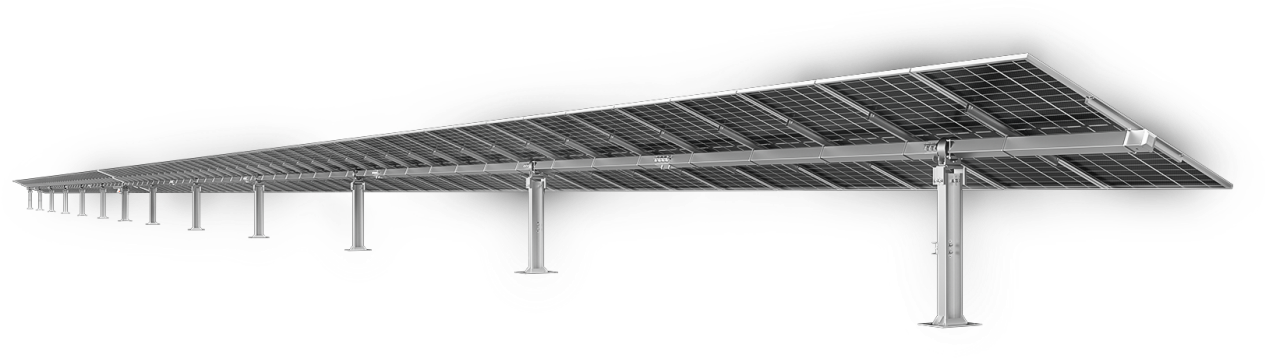
The TAI-Universal is a 2P multi-drive synchronous tracker engineered to maximize bifacial yield and optimize land utilization. Its upgraded 80-meter span and reduced pile count directly lower foundation costs. The multi-drive architecture distributes forces across multiple points, ensuring system stability and improving 25-year reliability in high-wind regions.
With N-S slope tolerance up to 20% and multiple foundation options, TAI-Universal adapts to diverse terrain while minimizing earthmoving.
With N-S slope tolerance up to 20% and multiple foundation options, TAI-Universal adapts to diverse terrain while minimizing earthmoving.
AT-Spark: Installation Efficiency and Material Optimization
The AT-Spark is Antaisolar's flagship 1P tracker, engineered for utility-scale projects where installation labor and material costs are critical LCOE levers. Its self-developed octagonal torque tube improves specific stiffness by 40% and specific strength by 50% while reducing material costs by up to 30%. The patented dual-spherical bearing design and quick-install bearing housing—"Snap. Flip. Twist."—improve core component installation efficiency by 25%, substantially reducing on-site labor. With 143-meter spans reducing pile quantity by 20% and 70 m/s wind resistance, AT-Spark delivers 25-year structural stability across extreme conditions.
Product Specifications Comparison Table
| Parameter | TAI-Simple | TAI-Universal | AT-Spark |
| Wind resistance | Up to 55 m/s | Up to 60 m/s | Up to 70 m/s |
| Certifications | IEC 62817, UL 3703, CE | IEC 62817 | IEC 62817, IP65, IK07 |
| Best-fit project profile | Standard terrain, LCOE-first | Large flat sites, bifacial modules | Complex terrain, rapid deployment |
| N-S slope tolerance | Up to 20% | Up to 20% | Up to 15% |
Note: All three products feature a tracking range of 120° (±60°), with TAI-Universal supporting a maximum of ±60°. For detailed quantitative data on pile reduction, installation efficiency, and material cost savings, refer to the product descriptions above.
Lifecycle Service as Part of the Cost Equation
Beyond hardware, Antaisolar’s lifecycle services directly impact LCOE:
• Yield simulation: SmartTrail™ algorithms optimize angles based on direct, diffuse, and reflected irradiance
• Delivery commitments: 8 global service centers, 25 GW annual production capacity
• O&M response terms: 24/48-Hour spare-part dispatch
• Extended warranty: Up to 10 years on drive and control, 15 years on structure
Evaluate the tracker versus fixed-tilt decision with a project-level financial model.
Antaisolar’s engineering team delivers site-specific yield simulations, terrain adaptability assessments, and bankable tracker specifications aligned with your PPA and financing requirements.
FAQ
What is the typical payback period for choosing a tracker over fixed-tilt?
Payback typically ranges from 3 to 7 years, depending on irradiance, electricity prices, and tracker design. In high-DNI regions with premium electricity markets, payback can be under 4 years. The solar tracker LCOE advantage compounds over the full 25-year project life, making trackers financially superior in most utility-scale applications despite longer payback than fixed-tilt.
How do you choose between 1P and 2P configurations?
1P (one module in portrait) configurations like TAI-Simple and AT-Spark offer:
Payback typically ranges from 3 to 7 years, depending on irradiance, electricity prices, and tracker design. In high-DNI regions with premium electricity markets, payback can be under 4 years. The solar tracker LCOE advantage compounds over the full 25-year project life, making trackers financially superior in most utility-scale applications despite longer payback than fixed-tilt.
How do you choose between 1P and 2P configurations?
1P (one module in portrait) configurations like TAI-Simple and AT-Spark offer:
• Lower structural complexity
• Faster installation
• Better performance on uneven terrain
• Lower CAPEX per watt
2P (two modules in portrait) configurations like TAI-Universal offer:
• Higher GCR (more DC capacity per land area)
• Enhanced bifacial gain through reduced rear-side shading
• Fewer foundations per MW
• Better economics for large, flat sites with bifacial modules
Selection rule: Choose 1P for complex terrain, rapid deployment, and LCOE-sensitive projects. Choose 2P for flat, large-scale sites where bifacial gain and GCR optimization drive better economics.
Sources
1. Wood Mackenzie-Global PV Tracker Market Share Report 2026 (cited for: single-axis tracker LCOE being the lowest in Europe, with 10% cost reduction in 2025)https://www.woodmac.com/reports/power-markets-global-solar-tracker-market-share-report-2026-150477673/
2. IRENA-Renewable Power Generation Costs in 2024 (cited for: single-axis tracker PV LCOE reaching as low as $37/MWh in the Middle East and Africa)https://www.irena.org/Publications/2025/Jun/Renewable-Power-Generation-Costs-in-2024
3. IEEE – Determining the Likely Tracking Choices for Utility Scale Photovoltaic Power Plants (cited for: energy gains ranging from 12.9% to 20.1% annually when comparing single-axis tracking systems to fixed-tilt PV solutions) https://ieeexplore.ieee.org/document/10751253
4. Applied Energy-A coupled optical-electrical-thermal model of the bifacial photovoltaic module, Volume 258, 2020 (cited for: bifacial gain under low irradiance is relatively high due to high diffuse fraction, indicating bifacial modules have an advantage in adapting to cloudy conditions)
https://doi.org/10.1016/j.apenergy.2019.114075
https://doi.org/10.1016/j.apenergy.2019.114075
end