
Are Solar Trackers Worth the Investment?
September 16, 2026
Single-axis solar trackers are generally worth the additional investment for utility-scale projects because their 10–15% higher upfront CAPEX can deliver approximately 15–25% more annual energy than fixed-tilt systems, improving project ROI and reducing LCOE over the asset’s lifetime. The economic advantage is strongest in high-DNI regions and projects using bifacial modules, where tracking helps maximize both front- and rear-side irradiance. However, the ROI is project-specific: latitude, terrain, project size, wind and snow conditions, and tracker design all affect the final economics. The key question is therefore not whether trackers cost more, but whether the additional energy yield and lifecycle savings outweigh the incremental CAPEX and operational requirements.
The Core Trade-off: CAPEX vs . Energy Yield
To understand the ROI, one must look beyond the initial price tag. The fundamental trade-off is between Capital Expenditure (CAPEX) and Energy Yield.
1. CAPEX
Tracking systems indeed have a higher hardware cost than fixed-tilt systems.
-
Cost Gap: Trackers typically carry a 10–15% CAPEX premium over fixed-tilt structures due to motors, gearboxes, and control systems.
-
"Hidden" Savings: However, advanced tracker designs are narrowing this gap. Antaisolar's AT-Spark, for example, reduces material costs by 30% through its octagonal torque tube, cuts pile counts by 20% via 143m spans, and improves installation efficiency by 25% with dual-spherical bearings—detailed in the cost optimization table below.
2. Energy Yield
The primary ROI driver of a tracking system is energy uplift.
-
The Gain: Single-axis trackers rotate to follow the sun, capturing 15–25% more energy annually compared to fixed-tilt systems. [NREL]
-
Bifacial Synergy: This gap widens with bifacial modules. Trackers elevate panels and minimize rear-side shading, maximizing the bifacial gain—a capability fixed-tilt systems cannot replicate efficiently.
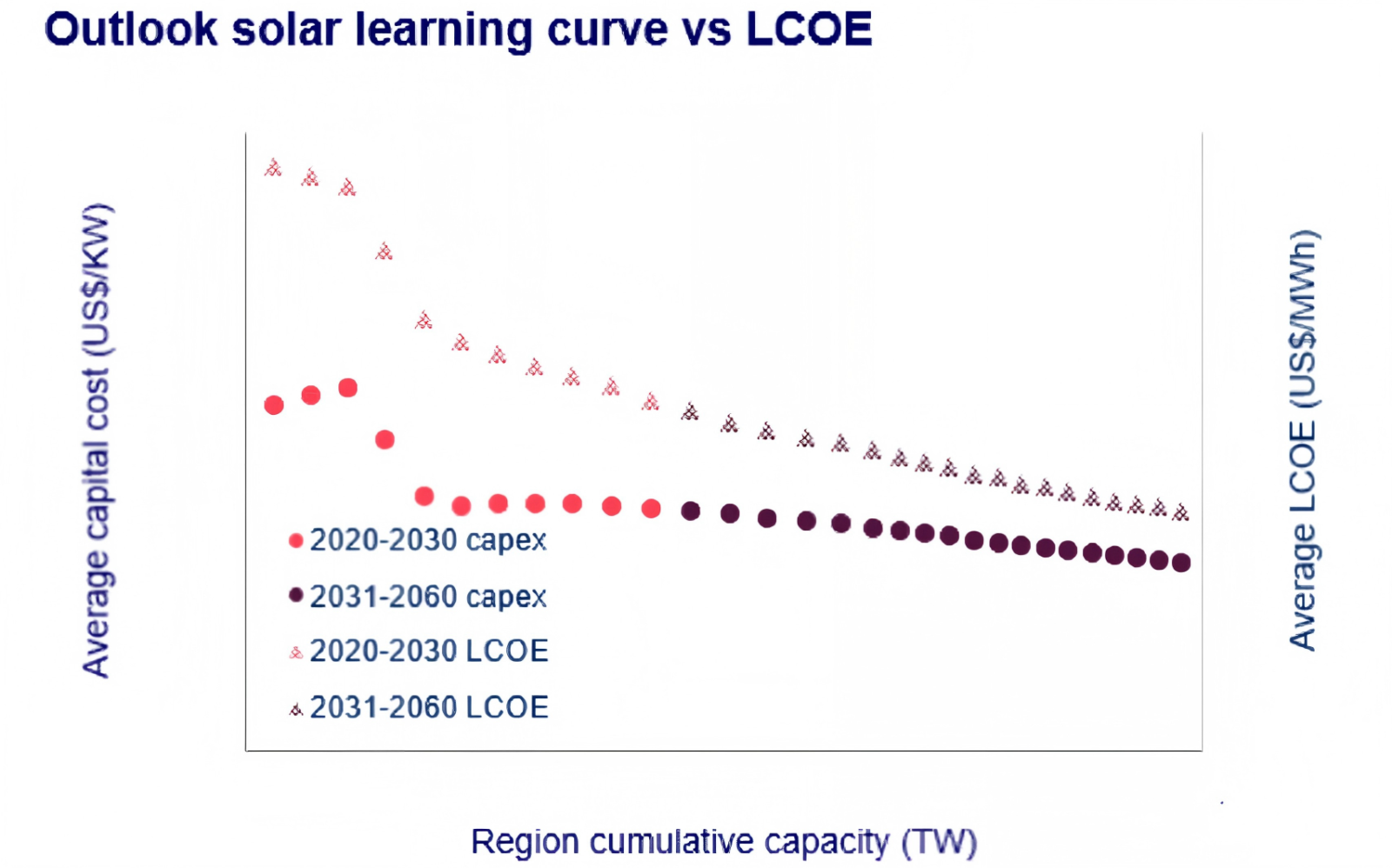
The Wood Mackenzie learning curve chart shows that as cumulative solar capacity scales, both CAPEX and LCOE decline steadily. For trackers specifically, this industry-wide cost reduction compounds with a project-level advantage: the 15–25% extra energy generated over a 25-year lifespan rapidly dilutes the 10–15% initial CAPEX premium, accelerating LCOE reduction beyond what fixed-tilt systems can achieve.
When Does a Tracker Provide the Best ROI?
Solar trackers generally provide the best ROI in utility-scale projects where the additional energy yield can more than offset the 10–15% CAPEX premium—particularly at low-to-mid latitudes, in high-DNI regions, and when trackers are paired with bifacial modules. High-latitude projects can also achieve strong returns when tracker designs are engineered for low sun angles and snow conditions. Conversely, the economics become less attractive for very small projects, high-diffuse-radiation climates, steep terrain, or sites with extreme wind conditions that require frequent stowing. Developers and EPCs should therefore evaluate tracker ROI across four factors: solar resource, latitude, terrain, and project scale, rather than applying a single industry-wide rule.
1. Scenario A: Low-to-Mid Latitudes
- The Challenge: In regions between 0° and 45° latitude, solar irradiance is abundant but highly variable throughout the day. Fixed-tilt systems, locked at a single angle, miss a significant portion of available irradiance during morning and afternoon hours. When bifacial modules are deployed on fixed-tilt structures, the rear side is often partially shaded by the mounting structure or adjacent rows, severely limiting the bifacial gain that module manufacturers promise.
Single-axis trackers dynamically follow the sun from east to west, keeping modules at the optimal angle of incidence throughout the day. This alone delivers 15%–25% more energy compared to fixed-tilt. When paired with bifacial modules, the synergy becomes even more powerful: the tracker's continuous adjustment ensures the rear side consistently captures reflected light (albedo) from the ground, while the elevated mounting height minimizes rear-side shading. The result is the lowest achievable LCOE for utility-scale projects. With a typical CAPEX premium of only 10%–15%, the payback period is 3–7 years, leaving 18+ years of pure profit advantage over the 25-year project lifecycle.
2. Scenario B: High-Latitude Regions
- The Challenge: At latitudes above 50° — such as Northern Europe, Canada, and Northern China — the sun remains at a consistently low elevation angle throughout the year. Fixed-tilt systems, optimized for a single static angle, cannot adapt to the dramatically shifting sun path between summer and winter. During winter months, when electricity demand peaks, fixed-tilt arrays suffer from severe underperformance, with actual energy yields falling far below design expectations.
This is precisely where tracking technology delivers its most counterintuitive advantage. A common misconception holds that trackers are less effective at high latitudes. In reality, the opposite is true: As solar elevation decreases, the relative advantage of tracking can become more pronounced. By dynamically adjusting the tilt angle throughout the day, trackers maintain the optimal angle between modules and sunlight at all times — something a fixed-tilt system simply cannot do when the sun crawls along the horizon. Field data shows energy gains of 20%–25% or even higher in high-latitude deployments. Modern products like the Antaisolar TAI-Simple and AT-Spark have also resolved the historical challenges of snow loads and low sun angles, making tracking technically viable where older designs failed.
3. Scenario C: Complex Terrain (Hills, Mountains, Desert)
- The Challenge: Complex terrain — including sand dunes, rolling hills, and mountainous sites with significant elevation changes — was traditionally considered a "no-go zone" for solar trackers. Standard tracker designs face three critical problems on such sites: (1) uneven wind load distribution across the tracker row, creating structural fatigue risks; (2) difficulty in installation due to the inability to conform to undulating ground; and (3) poor terrain adaptability, forcing developers to either abandon tracking or invest heavily in land grading — both of which erode ROI. [PV Tech]
Advanced tracking technology has fundamentally changed this equation. Antaisolar's Independent Drive Technology uses multi-rotation drive systems to distribute driving force evenly across the tracker row, significantly improving torsional rigidity and operational stability under sand-wind disturbance. The 143-meter ultra-long span design reduces pile counts and lowers the requirement for terrain leveling. Most critically, a 3D modeling-based customized layout algorithm generates independent pile coordinates for each tracker row, allowing the PV array to closely follow the original undulating terrain — a "one-site-one-strategy" approach that eliminates the need for expensive earthworks.
4. Scenario D: When Fixed-Tilt May Be the Better Choice
- High-diffuse-radiation climates (maritime, humid subtropical) where tracking yield advantage narrows to 8–12%
- Extremely small projects (<5MW) where tracker economies of scale don't apply
- Sites with slopes >15% where terrain adaptation costs erode the energy premium
- Regions with very high wind speeds where frequent stowing reduces effective tracking hours [pv magazine]
How Leading Manufacturers Ensure Realized ROI: The Antaisolar Approach
Leading solar tracker manufacturers turn theoretical ROI into realized project returns by optimizing three areas throughout the system lifecycle: energy performance, cost optimization, and risk mitigation. Energy performance increases the kilowatt-hours generated through intelligent tracking and better coordination with bifacial modules. Cost optimization reduces the CAPEX and installation burden through structural, foundation, and assembly innovations. Risk mitigation protects long-term generation by using environmental monitoring, automated stowing, and protection strategies for extreme weather. Antaisolar applies this three-pillar approach through its SmartTrail™ control system, AT-Spark structural design, and multi-layer weather protection, demonstrating that tracker ROI depends not only on energy gain at commissioning, but also on reliable performance and cost control throughout the project lifecycle.
1. Energy Performance — Maximizing Every Kilowatt-Hour
Hardware is only half the battle. Smart algorithms are the "multiplier" for energy performance.
Antaisolar's SmartTrail™ control system goes beyond conventional sun-position algorithms by simultaneously optimizing for direct, diffuse, and reflected irradiance using AI. Two scenarios highlight the difference:
Antaisolar's SmartTrail™ control system goes beyond conventional sun-position algorithms by simultaneously optimizing for direct, diffuse, and reflected irradiance using AI. Two scenarios highlight the difference:
- Overcast/High-Scattering Days: The AI calculates the optimal tilt for bifacial modules based on combined irradiance from both sides — rather than blindly tracking the sun's position. This captures significantly more diffuse light than fixed-tilt or basic tracking algorithms.
- Irregular Terrain: Built on 3D modeling and optimization algorithms, the system dynamically minimizes inter-row shading on uneven ground, maximizing energy yield where standard layouts would underperform.
2. Cost Optimization — Compressing Costs Across the Entire Chain
Innovation at the design stage is the most effective lever for improving ROI.
The AT-Spark tracker demonstrates this principle across these dimensions:
The AT-Spark tracker demonstrates this principle across these dimensions:
| Cost Driver | Innovation | Impact |
|---|---|---|
| Structure | Self-developed octagonal torque tube |
30% lower material cost |
| Foundation | 143m ultra-long span design | reduces foundation engineering volumes |
| Installation | "Snap-Flip-Lock"dual-spherical bearing | 25% faster core assembly |
3. Risk Mitigation — Protecting Returns Under Extreme Weather
The single greatest threat to long-term ROI is not CAPEX — it is unplanned downtime and structural failure during extreme weather events.
- Antaisolar's Multi-Layer Protection System: Each NCU (Network Control Unit) functions as a mobile weather station, equipped with precision sensors for real-time environmental monitoring. The system deploys 7-level wind speed protection strategies, automatically stowing trackers to safe positions as conditions escalate. Beyond wind, the system includes snow stow, flood stow, and hail stow — four intelligent protection modes that safeguard the asset against the full spectrum of extreme weather risks.
- Real Case Verification: In the Ningxia 32MW PV desert-control tracking project, facing the complex terrain of sand dunes, Antaisolar abandoned the traditional approach of massive land leveling and adopted a "one-site-one-strategy" customized solution. Its Independent Drive Technology distributes driving force evenly, and the multi-rotation drive scheme significantly improves overall torsional rigidity and operational stability under sand-wind disturbance. The 3D modeling-based customized layout algorithm generates independent pile coordinates for each tracker row, allowing the PV array to closely follow the original undulating terrain. The project ultimately achieved a 15%–20% increase in power generation compared to fixed mounts, proving that tracking systems can still deliver positive ROI even under challenging terrain conditions.
Conclusion
For utility-scale solar projects, single-axis trackers typically deliver the lowest LCOE: a 10–15% CAPEX premium is offset by 15–25% more energy over 25 years, with the strongest ROI in high-DNI regions, and meaningful advantages in high-latitude and bifacial deployments. Leading manufacturers like Antaisolar ensure these returns are realized in the field through energy performance optimization, systematic cost reduction, and multi-layer weather risk protection. As AI tracking algorithms and bifacial coordination advance, trackers' LCOE advantage will only widen—making them an essential factor in the lifecycle value competition of utility-scale solar.
FAQs
Q1: Are solar trackers worth the investment?
A: Yes, solar trackers can be worth the additional investment, particularly for utility-scale PV projects. Single-axis trackers can increase annual energy generation compared with fixed-tilt systems, helping offset their higher upfront CAPEX and potentially reducing LCOE over the project lifecycle.
Q2: How much more energy do solar trackers produce than fixed-tilt systems?
Single-axis solar trackers can typically generate approximately 15%–25% more annual energy than fixed-tilt systems, depending on site conditions and system design. The actual gain varies with solar resource, tracker configuration, backtracking strategy, terrain, and other project-specific factors.
Q3:Where do solar trackers provide the best ROI?
Solar trackers generally provide the strongest ROI in utility-scale projects with high solar irradiance, particularly high-DNI sites, where the additional energy generation can justify the higher system cost. Low-to-mid latitude projects and projects using bifacial modules can also benefit significantly. Developers should evaluate the solar resource and site-specific energy model rather than applying a universal ROI threshold.
Q4:When is fixed-tilt solar mounting a better choice than tracking?
Fixed-tilt systems may be more attractive when the additional energy yield from tracking is insufficient to justify the added CAPEX and operational complexity. This can occur in projects with highly diffuse solar radiation, very small project sizes, challenging slopes, or frequent high-wind stowing requirements. A project-level LCOE and energy-yield analysis should determine the optimal configuration.
Q5:How does extreme weather affect solar tracker ROI?
Extreme weather can affect tracker ROI through structural damage, forced stowing, downtime, and lost energy production. Wind is particularly important because trackers must balance energy capture with structural protection. Advanced systems can use environmental sensors, automated stowing, and dedicated wind, snow, flood, or hail protection strategies to reduce operational risk and protect long-term energy generation.
A: Yes, solar trackers can be worth the additional investment, particularly for utility-scale PV projects. Single-axis trackers can increase annual energy generation compared with fixed-tilt systems, helping offset their higher upfront CAPEX and potentially reducing LCOE over the project lifecycle.
Q2: How much more energy do solar trackers produce than fixed-tilt systems?
Single-axis solar trackers can typically generate approximately 15%–25% more annual energy than fixed-tilt systems, depending on site conditions and system design. The actual gain varies with solar resource, tracker configuration, backtracking strategy, terrain, and other project-specific factors.
Q3:Where do solar trackers provide the best ROI?
Solar trackers generally provide the strongest ROI in utility-scale projects with high solar irradiance, particularly high-DNI sites, where the additional energy generation can justify the higher system cost. Low-to-mid latitude projects and projects using bifacial modules can also benefit significantly. Developers should evaluate the solar resource and site-specific energy model rather than applying a universal ROI threshold.
Q4:When is fixed-tilt solar mounting a better choice than tracking?
Fixed-tilt systems may be more attractive when the additional energy yield from tracking is insufficient to justify the added CAPEX and operational complexity. This can occur in projects with highly diffuse solar radiation, very small project sizes, challenging slopes, or frequent high-wind stowing requirements. A project-level LCOE and energy-yield analysis should determine the optimal configuration.
Q5:How does extreme weather affect solar tracker ROI?
Extreme weather can affect tracker ROI through structural damage, forced stowing, downtime, and lost energy production. Wind is particularly important because trackers must balance energy capture with structural protection. Advanced systems can use environmental sensors, automated stowing, and dedicated wind, snow, flood, or hail protection strategies to reduce operational risk and protect long-term energy generation.
References
- NREL. Model and Validation of Single-Axis Tracking with Bifacial PV. National Renewable Energy Laboratory, 2019. https://research-hub.nlr.gov/en/publications/model-and-validation-of-single-axis-tracking-with-bifacial-photov/
- Wood Mackenzie. Renewable Levelized Cost of Electricity Competitiveness Reaches New Milestone Across Global Markets in 2025, 2025. https://www.woodmac.com/press-releases/renewable-levelized-cost-of-electricity-competitiveness-reaches-new-milestone-across-global-markets-in-2025/
- PV Tech. How Terrain-Following Trackers Are Helping Boost PV Project Viability, 2024. https://www.pv-tech.org/terrain-following-trackers-helping-boost-pv-project-viability/
- pv magazine. Passive Solar Tracker Wind Stowing Boosts Energy Production, 2024. https://www.pv-magazine.com/2024/05/08/passive-solar-tracker-wind-stowing-boosts-energy-production/
end